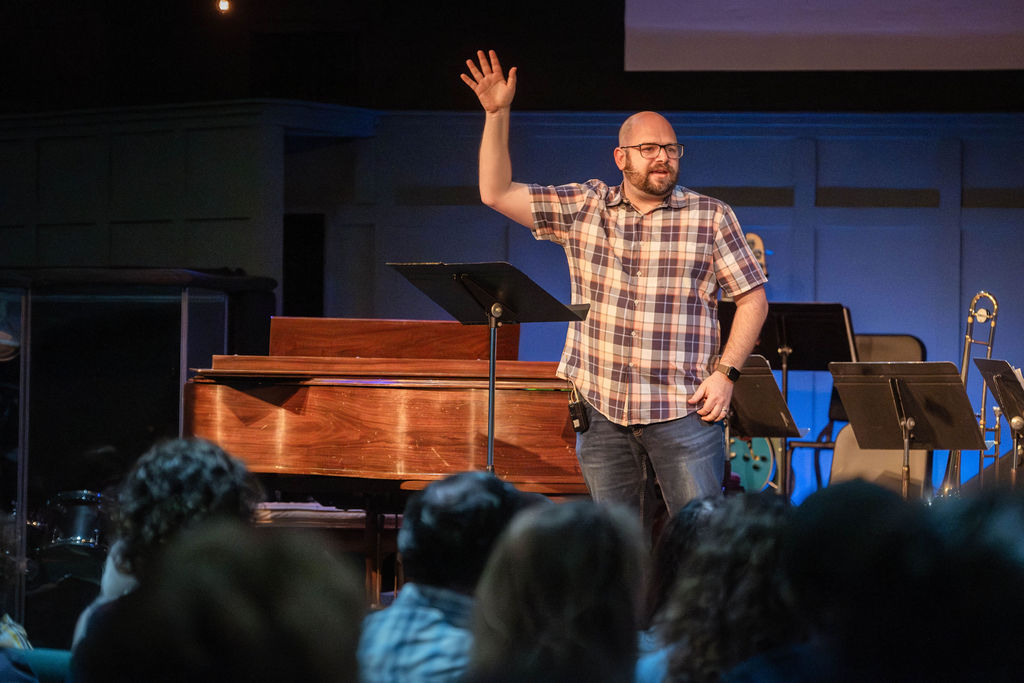
This past Sunday, Pastor Edward continued our series through Colossians with a message from Colossians 1:24–2:5. One phrase sat at the center of much of what he shared:
“Christ in you, the hope of glory.” Colossians 1:27
The mystery revealed
Edward began by talking about secrets. There’s something about hearing, “I want to tell you a secret,” that immediately makes us lean in.
But Paul is talking about a mystery God no longer intends to keep hidden. For generations, God had been unfolding His plan of rescue. Now something once hidden had been made clear: through Jesus, people from every nation could belong to God, and Christ would dwell in His people. That is the mystery Paul is celebrating: “Christ in you.”
I appreciated how Edward slowed down and helped us think about how big that statement really is. Christianity is not simply believing certain things about Jesus from a distance. Jesus has given His Holy Spirit to everyone who trusts in Him. So when Paul speaks about “Christ in you,” he is talking about the real presence of God with His people by His Spirit.
Christ is with you
That means you are not alone.
Edward talked about those moments when life gets dark, when pain becomes real, or when God can feel far away. Maybe it is a hospital room. Maybe it is the middle of the night when your mind will not slow down. Maybe it is grief or disappointment that feels hard to explain to anyone else.
Those are the moments we especially need to remember that Christ’s presence does not depend on our feelings. Jesus told His disciples, “I will not leave you as orphans.” Paul says elsewhere that the Spirit of God lives in those who belong to Christ. “Christ in you” is not simply a comforting thought. It is part of what it means to belong to Jesus.
Sitting at the table
But Paul does not stop with Christ’s presence. In the very next verse, he says his goal is to see people become “mature in Christ.” Christ does not simply comfort us. He changes us.
One of the images from the sermon that stuck with me was a table with two chairs. Imagine God sitting on one side and you sitting on the other. The point of the meeting is your transformation into the likeness of Jesus.
What does God bring to the table? Everything we cannot produce ourselves: grace, love, the power to change us. Even the desire to follow Him is something He is at work producing in us. What do we bring? We come honestly. We bring our weakness, our sin, our questions, and our willingness to respond to what God is doing.
Edward’s challenge was that many of us spend a lot of time running around the table without actually sitting down. We stay busy. We rush through prayer. We move from one responsibility to another. We may even spend a lot of time doing Christian things without slowing down long enough to be with God in prayer, hear Him through Scripture, confess what needs to be confessed, and respond to what He is showing us.
For some of us, “sitting at the table” this week may simply mean slowing down long enough to pray honestly, open Scripture without rushing, and pay attention to what God is teaching us.
That connects with something Paul says in this same passage:
“I labor for this, striving with his strength that works powerfully in me.” Colossians 1:29
Paul works hard, but he knows the power behind the work is not his own. That is an important distinction in the Christian life. Spiritual growth is not passive. We really do obey, turn from sin, learn, and make different choices. But we cannot make ourselves more like Jesus by sheer effort. God is the one at work in us.
Paul goes on in chapter 2 to say that he wants these believers strengthened, joined together in love, and settled in their understanding of Christ. He also wants them protected from arguments that sound convincing but are not true.
In other words, growing as a Christian is not simply about knowing more information. It means becoming more grounded in what is true, more shaped by love, and less easily moved by whatever sounds persuasive in the moment.
The hope of glory
Edward also spent time on the last part of Paul’s phrase: “the hope of glory.”
He used the famous painting The Raft of the Medusa to picture the difference hope can make. The painting shows shipwreck survivors stranded at sea. Some have collapsed. Some seem to have given up. But others are still looking toward the horizon, waving toward a ship in the distance. They still believe rescue may be coming.
There are plenty of reasons people lose hope. Sometimes we give up on relationships, dreams, callings, or even our own ability to change. But Christians have a reason to keep lifting our heads.
Our hope is not that everything in this life will eventually turn out the way we want. It is not that we will finally get ourselves together. Our hope is Christ.
When Paul talks about “glory,” he is looking ahead to the future God has promised: the day when Christ returns, His work in us is complete, and we are with Him forever. The Christ who is present with us now is also the Christ who will bring us into that future.
That was one of the things I appreciated most about Edward’s message. “Christ in you” speaks to where we are right now and where God is taking us. His presence means we are not abandoned. His power means transformation does not finally depend on us. And His promise gives us hope when life feels uncertain.
Edward unpacked all of this with stories and illustrations I cannot capture here, so I’d encourage you to hear the whole message for yourself. And if you do, take a few quiet minutes afterward and ask God one simple question: Where have I been running around the table instead of sitting with You?
Christ in you, the hope of glory.